The Crypto Phishing Epidemic: How Attackers Stole $300 Million in January 2026 Alone

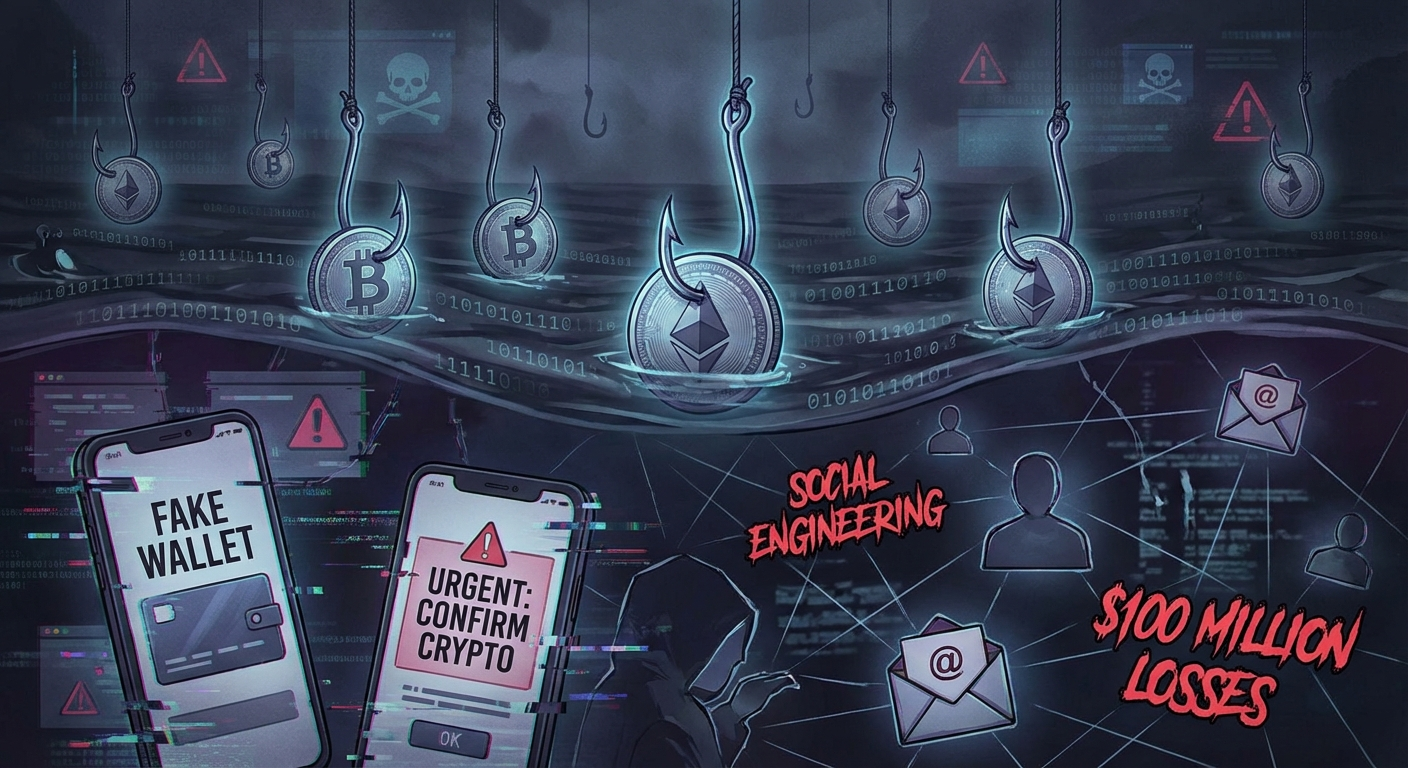
When code becomes harder to exploit, hackers exploit humans instead. The results are catastrophic.
Executive Summary
January 2026 will be remembered as a watershed moment in cryptocurrency security—not for protocol failures, but for something far more troubling. While the industry has spent billions fortifying smart contracts and blockchain infrastructure, attackers quietly pivoted to the weakest link in the security chain: us.
The numbers tell a devastating story. According to blockchain security firm CertiK, total cryptocurrency losses in January 2026 reached approximately $370 million—the highest monthly total in 11 months. But buried within that headline figure is a more alarming revelation: phishing scams alone accounted for $311.3 million, representing nearly 84% of all losses. That's more than 3.5 times the $86 million lost to actual protocol hacks.
The message from attackers is clear: why spend months finding a zero-day vulnerability in a smart contract when you can simply trick someone into signing away their life savings in under 60 seconds?
The Paradigm Shift: From Code to Humans
For years, the cryptocurrency industry has operated under an implicit assumption: security means secure code. The response to every major hack has been predictable—more audits, more bug bounties, more formal verification. And to some extent, it's working. Smart contract exploits are becoming increasingly sophisticated, requiring attackers to invest significant resources to find vulnerabilities.
"Code is getting harder to exploit," noted security researchers at NOMINIS in their January 2026 monthly report. "Attackers are increasingly shifting focus away from code-level vulnerabilities toward exploiting authorization, trust, and operational access within the crypto ecosystem."
The statistics bear this out. While 16 protocol hacks occurred in January 2026, resulting in $86.01 million in losses—a 13.25% increase from December 2025—these figures pale in comparison to phishing losses. For every dollar lost to smart contract exploits, nearly four dollars were stolen through social engineering and phishing attacks.
This isn't a temporary fluctuation. It represents a fundamental evolution in the threat landscape. Attackers have performed their own cost-benefit analysis and reached an uncomfortable conclusion: humans are cheaper to exploit than code.
Anatomy of a $282 Million Tragedy
On January 10, 2026, a single private user suffered what would become the largest individual phishing loss in cryptocurrency history: $282 million in Bitcoin and Litecoin.
The attack didn't involve any novel technical exploit. There was no smart contract vulnerability, no protocol failure, no infrastructure compromise. Instead, the victim—a sophisticated holder who understood the importance of hardware wallets—was methodically manipulated through social engineering.
According to on-chain investigator ZachXBT, who first exposed the incident, the attacker employed what's known as a "hardware wallet social engineering attack." Despite the victim using cold storage—the industry's gold standard for security—they were psychologically manipulated into signing malicious transactions that authorized the transfer of their funds.
The aftermath was swift and brutal. The stolen Bitcoin and Litecoin were immediately converted to Monero through multiple instant exchanges, exploiting the privacy coin's untraceable nature. The sudden influx of funds caused Monero's price to spike sharply—a grim market indicator of the heist's scale.
This single incident accounted for approximately 75% of all January 2026 losses. It demonstrates a terrifying truth: cold storage protects your keys, not your judgment.
The Five Horsemen of Crypto Phishing
Understanding how attackers operate is the first step toward defense. January 2026 showcased the full arsenal of modern phishing techniques, each exploiting different psychological and technical vulnerabilities.
1. Approval Phishing: The Permission Trap
Approval phishing has become the most financially devastating attack vector in cryptocurrency. According to Chainalysis research, this technique has enabled attackers to steal at least $1 billion since 2021, with the true figure likely much higher.
How it works: Every time you interact with a decentralized application, you're often asked to sign an "approval" transaction. This transaction grants the dApp permission to spend tokens from your wallet. Legitimate dApps need these permissions to function—you can't swap tokens on Uniswap without giving Uniswap permission to access your tokens.
Attackers exploit this familiarity. They create convincing fake interfaces that prompt users to sign approval transactions that grant unlimited spending permission not to a legitimate smart contract, but to an attacker-controlled address.
The January 2026 example: On January 3, a private user lost $1.08 million after signing a malicious "permit" signature. The victim believed they were interacting with a legitimate DeFi protocol. Instead, they unknowingly granted a third party authorization to transfer their $aEthLBTC tokens directly from their wallet.
What makes permit signatures particularly dangerous is that they operate off-chain. Unlike traditional approval transactions that are visible on the blockchain before execution, permit signatures are signed locally and can be executed by the attacker at any time—even days or weeks later.
"No protocol vulnerability was exploited," the NOMINIS report noted. "The transfer was executed using a valid authorization provided by the user."
2. Address Poisoning: The Copycat Killer
Address poisoning exploits a fundamental usability problem in cryptocurrency: wallet addresses are impossible to remember. The typical Ethereum address—40 hexadecimal characters—looks something like this:
0x71C7656EC7ab88b098defB751B7401B5f6d8976F
No human can memorize that. So users do what humans always do when faced with complex strings: they copy and paste from their transaction history.
Attackers have weaponized this behavior at industrial scale.
How it works: The attacker generates a "lookalike" address that matches the first and last few characters of an address the victim frequently transacts with. Because most wallet interfaces truncate addresses (showing only something like "0x71C7...976F"), the lookalike appears identical to the legitimate address.
The attacker then "poisons" the victim's transaction history by sending a tiny amount of cryptocurrency—or even a zero-value transaction—from the lookalike address. When the victim later initiates a transaction and copies an address from their history, they may grab the poisoned address instead of the legitimate one.
The scale is staggering. A Carnegie Mellon University study published in January 2026 analyzed two years of blockchain data and identified approximately 270 million attack attempts targeting 17 million victims, with confirmed losses of at least $83.8 million between July 2022 and June 2024.
The January 2026 catastrophe: On the last day of the month, a user fell for exactly this attack, losing 4,556 ETH—approximately $12.25 million—in a single transaction. The victim copied what they believed was a trusted address from their history. It wasn't.
"The important issue here is that blockchain transactions are not reversible," explained Taro Tsuchiya, the CMU researcher leading the study. "Once you make a mistake, you won't be able to recover anything."
3. Fake Wallet Applications: The Counterfeit Vault
The simplest phishing attacks remain devastatingly effective. Fake wallet applications—malicious software masquerading as legitimate wallet software like MetaMask, Trust Wallet, or Ledger Live—continue to claim victims daily.
How it works: Attackers create pixel-perfect clones of popular wallet applications and distribute them through search engine ads, app stores (briefly, before removal), social media, and phishing emails. When users enter their seed phrases into these fake wallets, the attackers immediately gain full control of all associated funds.
In January 2026, security firm SlowMist issued an urgent warning about a new MetaMask phishing campaign. The attack masqueraded as a "2FA upgrade" notification, directing users to cloned interfaces that harvested seed phrases under the guise of a security enhancement.
The psychological manipulation is sophisticated. Users are told their funds are at risk—that they need to "upgrade" immediately to protect themselves. The irony is cruel: the very action users take to protect themselves is what destroys them.
4. Fake Airdrop Scams: The Free Money Trap
Cryptocurrency culture celebrates airdrops—free token distributions that can sometimes be worth thousands of dollars. Attackers exploit this expectation relentlessly.
How it works: Scammers announce fake airdrops through social media, email campaigns, and even targeted messages to known whale addresses. To "claim" the airdrop, victims are directed to malicious websites that either:
- Request seed phrase entry (immediate total loss)
- Prompt signing of approval transactions (delayed drainage)
- Trigger malware downloads (keyloggers, clipboard hijackers)
The psychological hook is powerful: free money with no effort required. But there's always a catch—usually a request to "connect wallet" or "verify eligibility" that leads directly to fund loss.
5. Romance and Long-Term Social Engineering
The most insidious phishing attacks unfold over weeks or months. Romance scammers—sometimes called "pig butchering" scammers—build genuine-seeming relationships before striking.
How it works: Attackers invest significant time cultivating trust. They may pose as romantic interests, crypto mentors, investment advisors, or fellow traders. Once trust is established, they introduce a "special opportunity" requiring the victim to interact with a specific platform or sign specific transactions.
This technique explains how sophisticated, security-conscious investors—people who know never to share their seed phrases—still fall victim. The attack doesn't come from a stranger asking for your password. It comes from someone you believe you know, asking you to try out a promising new DeFi protocol.
According to Chainalysis, romance scam-style approval phishing has become the dominant vector for large-value individual losses. The $282 million January loss fits this pattern perfectly: an extended social engineering campaign culminating in the victim's willingness to sign transactions they fundamentally shouldn't have trusted.
The Hardware Wallet Illusion
If there's one security myth January 2026 shattered completely, it's that hardware wallets provide complete protection.
Hardware wallets are excellent at what they're designed to do: they keep your private keys isolated from internet-connected devices. Your seed phrase never leaves the secure element. Malware on your computer cannot extract your keys.
But here's what hardware wallets cannot do: they cannot evaluate whether a transaction you're signing is malicious.
When you approve a transaction on your Ledger or Trezor, the device displays what you're signing. The problem is that most users don't understand—and many interfaces don't clearly communicate—what they're actually authorizing.
A malicious approval transaction looks nearly identical to a legitimate one. Both display a contract address. Both request permission to spend tokens. The difference is intent—and intent is invisible on a hardware wallet screen.
"Cold storage and hardware wallets did not prevent loss when authorization was compromised," the NOMINIS January report stated bluntly.
The Holdstation incident on January 29 illustrated another hardware wallet limitation. A core developer's device was compromised through a malicious browser extension, exposing an admin private key. The hardware wallet was irrelevant because the compromise occurred at the operational layer—the system through which the developer accessed their funds.
The uncomfortable truth: Hardware wallets are a critical security layer, but they're not a substitute for security awareness. They protect against one attack vector (key extraction) while remaining helpless against others (social engineering, approval phishing, operational compromise).
The Psychology of Victimization
Why do even experienced users fall for phishing attacks? The answer lies in the intersection of human psychology and deliberate manipulation.
Urgency and Fear
Attackers manufacture emergencies. "Your funds are at risk." "This offer expires in 10 minutes." "Unauthorized access detected—verify immediately." Under time pressure, humans make mistakes. We bypass our normal verification routines. We click first and think later.
The fake MetaMask 2FA upgrade campaign exploited this perfectly: users believed their security was compromised and rushed to "fix" the problem, not recognizing that the fix itself was the attack.
Authority and Trust
Scammers present themselves as authoritative figures: customer support agents, security researchers, project developers, successful traders. Humans are wired to defer to authority. When someone who appears knowledgeable tells us to take action, we're predisposed to comply.
Long-term social engineering amplifies this effect. After weeks of relationship building, the attacker isn't a stranger—they're a trusted friend whose recommendations carry weight.
Familiarity and Habituation
Crypto users sign transactions constantly. Connect wallet, approve spend, confirm swap, sign message. The repetitive nature of these interactions breeds familiarity—and familiarity breeds carelessness.
Attackers exploit this habituation. They craft requests that look exactly like the hundreds of legitimate requests users have processed before. The malicious transaction hides among the routine, distinguished only by details that users have learned to skip past.
Greed and FOMO
Free airdrops. Exclusive investment opportunities. 10,000% APY yields. The crypto space normalizes extraordinary returns, making scam promises seem almost reasonable. When everyone around you is talking about getting rich from random token distributions, the fake airdrop email seems less suspicious.
Cognitive Overload
Modern DeFi is genuinely complex. Users interact with dozens of protocols across multiple chains, each with different interfaces and transaction patterns. Maintaining perfect security hygiene across this complexity is exhausting. Eventually, attention slips—and that's when attackers strike.
Practical Protection: Building Your Defense
The good news: phishing attacks, unlike smart contract exploits, can be substantially prevented through individual action. You don't need to audit blockchain code to protect yourself. You need to change your behavior.
Token Approval Hygiene
Use Revoke.cash regularly. This free tool allows you to view and revoke token approvals across more than 100 networks. Every approval you've ever granted remains active until explicitly revoked—even if you haven't used the protocol in years. Routine cleanup eliminates this accumulated risk.
Best practice: After completing any DeFi session, especially with unfamiliar protocols, check your approvals. If you don't plan to interact with a protocol again soon, revoke the approval immediately.
Limit approval amounts. When prompted to approve unlimited token spending, consider editing to the specific amount needed. Yes, you'll pay another gas fee if you need to approve more later. That's a small price for dramatically reduced risk.
Address Verification Protocols
Never copy addresses from transaction history. This behavior is precisely what address poisoning exploits. Instead:
- Use address book features that verify addresses before storage
- For frequent recipients, save addresses in a password manager or secure note
- When sending to a new address, verify through multiple channels
Triple-check high-value transactions. For any transaction above your personal threshold (define this in advance—$1,000, $10,000, whatever makes sense for you):
- Verify the address character by character, not just start and end
- Confirm with the recipient through a different communication channel
- Send a small test transaction first
Be suspicious of small incoming transactions. Random dust or zero-value transfers may be poisoning attempts. Don't use those addresses.
Signature Awareness
Understand what you're signing. This is harder than it sounds, but increasingly critical. Key distinctions:
- Direct transfers: You're sending funds directly. Visible and understandable.
- Approvals: You're granting permission for a smart contract to spend your tokens. These persist until revoked.
- Permit signatures: You're signing off-chain permission that can be executed later. Extremely dangerous if malicious.
- Arbitrary messages: Some signatures authorize actions without clear on-screen explanation. Treat with extreme caution.
When in doubt, reject. Unlike legitimate services that will explain what they need, attackers pressure you to act quickly. If you're uncertain about a signature request, close the window. Research. Ask for help. There's no legitimate crypto transaction that can only happen in the next 30 seconds.
Software and Environment Security
Download only from official sources. Verify URLs carefully. Bookmark official sites rather than relying on search results. Check domain names character by character—attackers use lookalikes like "metamask.io" vs "mетаmask.io" (with Cyrillic characters).
Be paranoid about browser extensions. The Holdstation developer was compromised through a malicious extension. Minimize extensions in your crypto browser. Consider using a dedicated browser profile for crypto activities with minimal extensions.
Keep software updated. Malware exploits known vulnerabilities. Updates patch these vulnerabilities. Don't postpone.
Psychological Defense
Implement a cooling-off period. Before any significant transaction—especially one prompted by external contact—wait. An hour. A day. Time dissolves urgency-based manipulation.
Verify through back channels. If "MetaMask support" contacts you, don't respond through the same channel. Navigate to MetaMask's official website and use their official support channels. Legitimate organizations won't mind.
Recognize that you're a target. Blockchain addresses with significant balances are visible to everyone. High-value holders are specifically targeted. Act accordingly.
The Actionable Security Checklist
Print this. Follow it. Update it. Your crypto security depends on consistent practice, not one-time setup.
Daily Practices
- [ ] Verify every address character-by-character before sending
- [ ] Reject any signature you don't fully understand
- [ ] Use bookmarks, never search results, for crypto sites
- [ ] Check that URLs match official domains exactly
Weekly Practices
- [ ] Review and revoke unnecessary token approvals via Revoke.cash
- [ ] Check for unexpected small transactions (potential poisoning)
- [ ] Update wallet software and browser
- [ ] Review permissions granted to connected dApps
Monthly Practices
- [ ] Audit all wallet addresses for unexpected token approvals
- [ ] Review saved addresses in address book for accuracy
- [ ] Check browser extensions—remove any you don't recognize
- [ ] Verify hardware wallet firmware is current
Before High-Value Transactions
- [ ] Send a small test transaction first
- [ ] Verify recipient address through a separate channel
- [ ] Wait for cooling-off period (self-defined, minimum 1 hour)
- [ ] Confirm transaction details on hardware wallet match intended action
Red Flags Requiring Immediate Rejection
- Any request for your seed phrase or private keys (ALWAYS SCAM)
- Urgency language: "Act now," "Limited time," "Your funds at risk"
- Unsolicited contact about "opportunities" or "problems"
- Requests to sign unfamiliar transaction types
- Interfaces that don't exactly match official versions
Conclusion: The Human Layer Cannot Be Automated Away
January 2026's $300+ million in phishing losses represents more than a bad month. It's a declaration that cryptocurrency's greatest vulnerability isn't in its code—it's in its users.
The industry has responded to smart contract exploits with formal verification, multiple audits, bug bounties, and upgrade patterns. But there is no equivalent technical solution for human manipulation. You cannot audit away social engineering. You cannot patch gullibility. You cannot fork away trust.
This reality demands a fundamental shift in how we approach crypto security. Technical infrastructure remains essential, but it's no longer sufficient. The next frontier of crypto security is behavioral: changing how users interact with the ecosystem, building habits that resist manipulation, and accepting that vigilance is not optional.
The $282 million victim used a hardware wallet. They were presumably sophisticated enough to accumulate that much wealth. They still lost everything.
That could be any of us. The only difference between that victim and the rest of us is the particular moment when we let our guard down.
Don't let that moment come for you.
Data sources: CertiK January 2026 Security Report, NOMINIS Monthly Report, PeckShield Alert, Chainalysis Research, Carnegie Mellon CyLab, SlowMist Threat Intelligence, ZachXBT on-chain analysis.